


Have a question
Early Detection Saves Lives
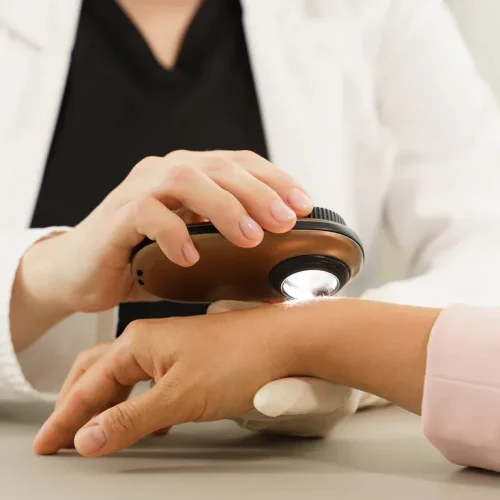
Regular skin checks are essential for the early detection and prevention of skin cancer, helping to identify suspicious moles or lesions before they become serious. Our experienced skin cancer doctors use advanced dermoscopy and mole mapping to provide thorough, professional skin cancer screenings.
TREATMENT PROCESS
Consultation
Full-Body Skin Examination
Discussion of Findings
Treatment Plan or Follow-Up
Why Regular Skin Checks Are Essential
Australia has one of the highest rates of skin cancer in the world, with two in three Australians diagnosed with skin cancer by age 70. Early detection is key to successful treatment, as skin cancers like melanoma, basal cell carcinoma (BCC), and squamous cell carcinoma (SCC) can spread if left untreated. A professional skin check helps detect abnormalities early, reducing the risk of serious complications.
Skin Cancer Prevention & Early Detection
- Wear broad-spectrum SPF 50+ sunscreen daily, even on cloudy days.
- Avoid peak sun hours (10 AM – 4 PM) and seek shade when outdoors.
- Wear protective clothing, including hats and sunglasses.
- Reapply sunscreen every two hours, especially after swimming or sweating.
- Check your skin regularly for new or changing moles.
- Asymmetry – One half of the mole doesn’t match the other.
- Border – Irregular, scalloped, or poorly defined edges.
- Colour – Multiple colours or uneven shades.
- Diameter – Larger than 6mm or increasing in size.
- Evolving – Changes in size, shape, colour, or sensation (itching, bleeding).
- Perform a monthly full-body skin check using a mirror or with the help of a partner.
- Look for new, changing, or unusual moles, spots, or skin growths.
- Monitor any sores that don’t heal or itchy, bleeding, or crusting lesions.
- If you notice suspicious changes, book a professional skin cancer check immediately.
Why Choose Horizon Medical Centre for Skin Cancer Checks?
At Horizon Medical Centre Stepney, we specialise in comprehensive skin cancer screening and early detection. Our expert skin cancer doctors, led by Dr Amarnath Bhat, use state-of-the-art dermoscopy and mole mapping to assess skin abnormalities with precision. We provide thorough full-body skin examinations, on-site biopsies, surgical excisions, and early treatment options, ensuring accurate diagnosis.
FREQUENTLY ASKED QUESTIONS
Individuals at high risk (fair skin, sun exposure history, family history of melanoma) should have annual skin checks, while others should have a full-body examination every one to two years.
Our doctor will examine your skin from head to toe using a dermatoscope to detect suspicious moles or lesions. If needed, we may perform digital imaging (mole mapping) or a biopsy for further analysis.
Yes. Early detection significantly increases treatment success rates. Most non-melanoma skin cancers (BCC, SCC) and early-stage melanomas can be completely removed if diagnosed in time.
Follow the ABCDE rule of melanoma:
- Asymmetry
- Border irregularity
- Colour changes
- Diameter larger than 6mm
- Evolving appearance
If you notice any of these signs, book a skin cancer check immediately.
No, a skin check is non-invasive and painless. If a biopsy is needed, local anaesthesia is used to ensure minimal discomfort.
Mole mapping uses high-resolution digital imaging to track changes in moles over time, helping detect melanoma in its earliest stages. It's recommended for high-risk individuals with multiple moles or a history of skin cancer.
If a mole changes in size, colour, or shape, bleeds, or becomes itchy, book a professional skin cancer check immediately for evaluation.
Some aspects of skin checks may be bulk-billed, while procedures like mole mapping and biopsies may require an out-of-pocket fee.
Yes, we offer medical and cosmetic mole removal using minimally invasive techniques.